AI Economics
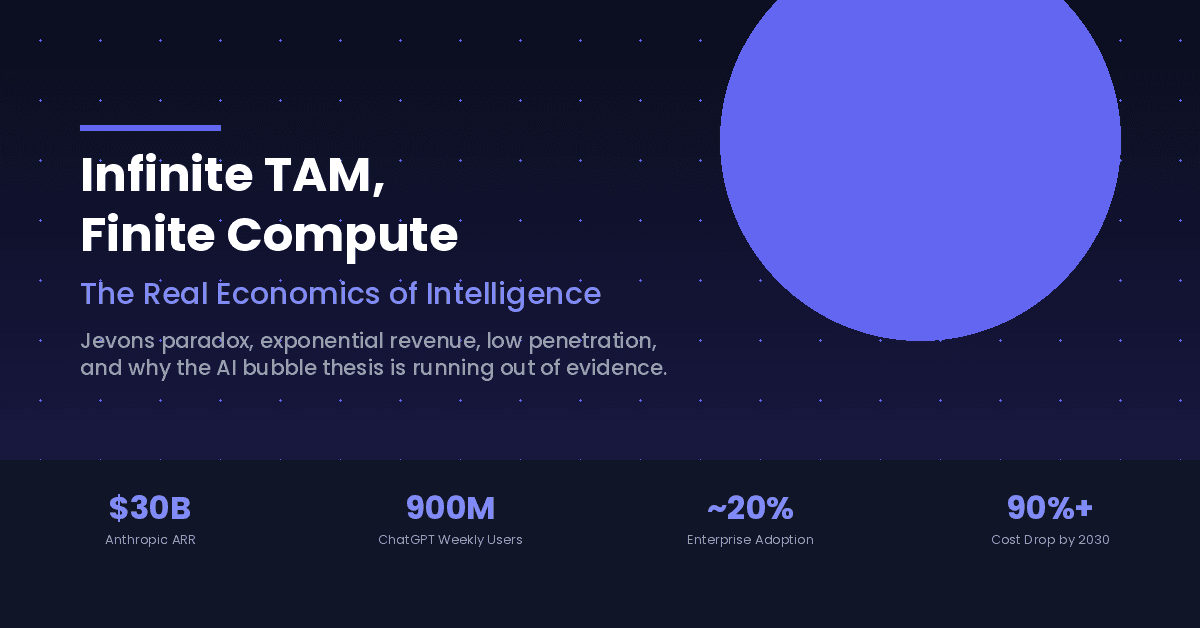
The TAM for Intelligence Is Larger Than We Think
Fifteen months ago, Anthropic was a $1 billion revenue business. Today it is a $30 billion one. That is not a typo.
In the same period, ChatGPT grew from 400 million to 900 million weekly active users. OpenAI crossed $25 billion in annualised revenue. Enterprise customers spending over $1 million annually with Anthropic doubled from 500 to 1,000 in under two months.
These are not the signals of a speculative bubble. They are the signals of a market whose total addressable size is being systematically underestimated.
For years we sized technology markets in familiar buckets: software TAM, cloud TAM, services TAM, advertising TAM. AI is breaking those categories apart.
Intelligence is no longer a feature inside software. It is becoming a programmable layer that sits across workflows, devices, interfaces, and increasingly autonomous systems. If intelligence becomes abundant, cheap, and deployable almost everywhere, the addressable market is no longer a narrow AI software category. It starts to resemble the market for better decisions, faster execution, lower coordination cost, richer personalisation, and entirely new classes of digital labour.
Not because the market is literally infinite. Energy, compute, budgets, regulation, and organisational readiness all still matter. But the market for intelligence appears to be economically open-ended in a way traditional software categories are not. As the unit cost of intelligence falls, the number of viable use cases expands. And as model capability rises, each workflow can consume more intelligence, not less.
That is the setup for a Jevons paradox market.
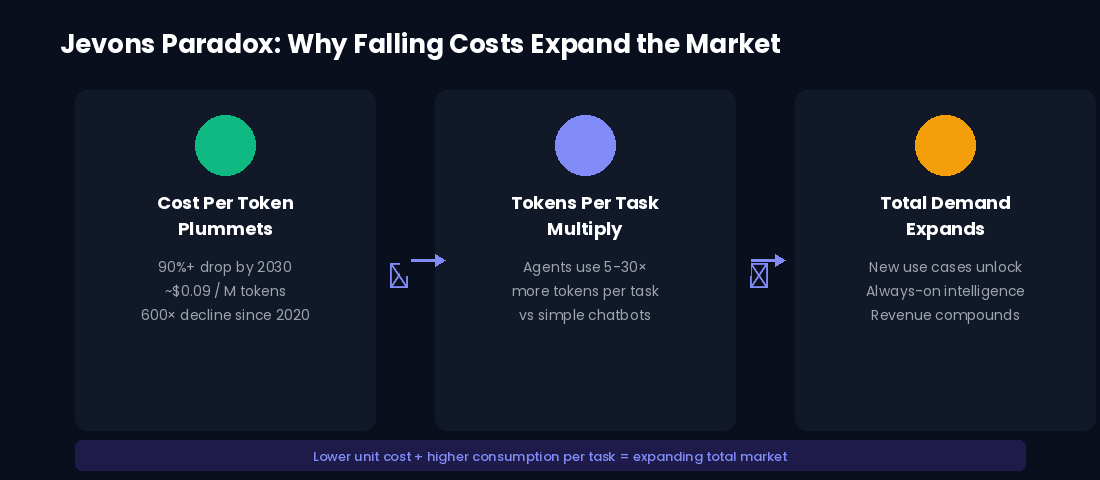
Jevons paradox: why falling costs expand the market
Jevons paradox tells us that when efficiency improves, total consumption can rise rather than fall. We saw it with coal. We saw it with computing. We saw it with bandwidth and storage. We are beginning to see it with intelligence.
Gartner forecasts that by 2030, performing inference on a one-trillion-parameter model will cost providers more than 90% less than in 2025, and that these models will be up to 100 times more cost-efficient than similarly sized early models from 2022. Those gains come from better semiconductors, model design, higher utilisation, inference-specific silicon, and increased use of edge devices.
Meanwhile, academic analysis of token pricing suggests that economy-tier inference prices have already fallen roughly 600-fold since 2020, with some models around $0.09 per million tokens by early 2026. At that price, processing a 100-page document costs approximately $0.003. Intelligence becomes essentially free for simple tasks like email sorting, basic customer support, or grammar checking, which is why we are seeing AI integrated into almost every app and device.
The real unlock: more intelligence consumed per task
Gartner notes that agentic models can require 5 to 30 times more tokens per task than a standard chatbot. A chatbot produces an answer. An agent reasons across steps, calls tools, retrieves context, evaluates options, retries, plans, and executes actions. Each useful unit of work consumes materially more intelligence.
So the economics move in two directions at once. The cost per token is falling sharply, and the tokens consumed per useful task can rise dramatically as systems become more agentic.
The market does not have to choose between lower prices and higher demand. It can have both. Intelligence gets cheaper per unit, but richer workflows consume more of it. The result is not a collapse in value. It is a broadening and deepening of demand.
This is why the argument that token optimisation kills the market misses the point. Routing, caching, smaller specialist models, better context handling, and hybrid model stacks will all push effective unit costs down further. But that does not shrink the market. It opens the door to always-on intelligence in thousands of use cases that were previously too expensive to justify.
Revenue is now scaling exponentially
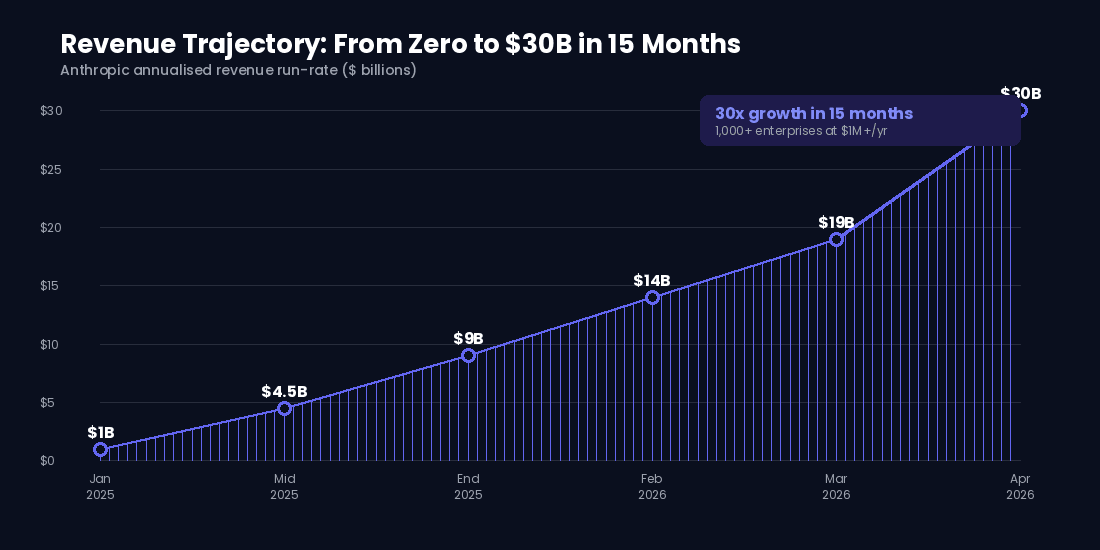
Anthropic: enterprise demand is real and accelerating. Anthropic's annualised revenue run-rate trajectory in 2026 has been remarkable: approximately $9 billion at the end of 2025, $14 billion in February 2026, $19 billion in March, and more than $30 billion in April. That is a more than threefold increase in roughly four months.
The number of enterprise customers spending over $1 million annually doubled from 500 to 1,000 in less than two months. Claude Code alone was generating over $2.5 billion in annualised run-rate revenue by February. Anthropic also announced a compute agreement with Google and Broadcom for approximately 3.5 gigawatts of next-generation TPU capacity starting in 2027.
OpenAI: consumer intelligence as a mass utility. If Anthropic is proving enterprise willingness to pay, OpenAI is proving intelligence can behave like a mass consumer utility. ChatGPT reached 900 million weekly active users as of February 2026, up from 400 million a year earlier. It now has over 50 million paying consumer subscribers and more than 9 million paying business users. Annualised revenue exceeds $25 billion, with OpenAI reporting $2 billion in monthly revenue. 92% of Fortune 500 companies use the platform.
AI is no longer just one thing. It is simultaneously a consumer utility used weekly by nearly a billion people and an enterprise production layer monetised across APIs, coding, workflow augmentation, and agentic execution. That is not how narrow software categories behave. It is how foundational infrastructure behaves.
Intelligence does not just replace software, it replaces services
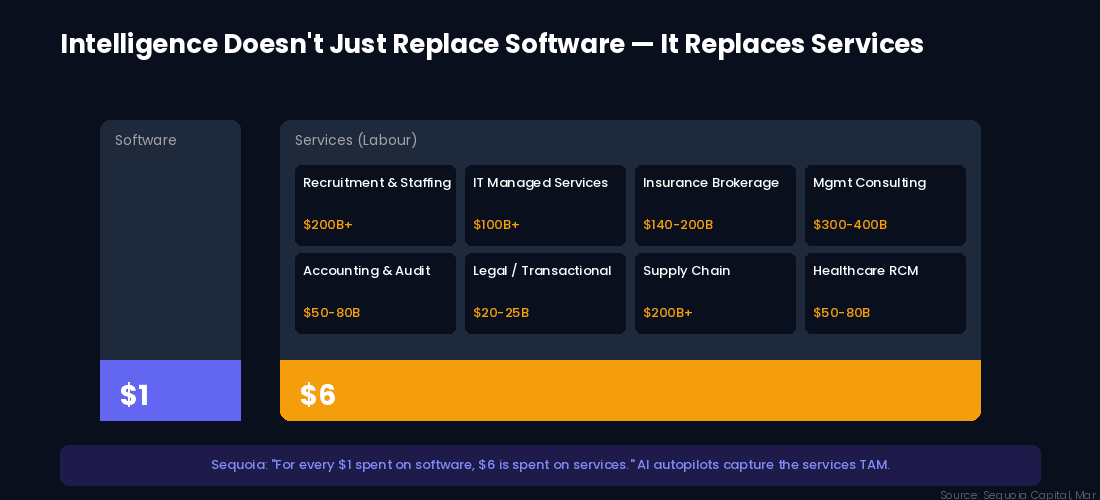
Here is where the argument gets larger. Sequoia Capital's Julien Bek framed it sharply in March 2026: for every dollar spent on software, six are spent on services. If AI is only competing for the software budget, we are measuring the wrong market.
The key insight is the distinction between selling the tool and selling the work. A copilot sells the tool, making a professional more productive. An autopilot sells the work, and the customer buys the outcome directly. When AI becomes capable enough, the addressable market shifts from the tool budget to the labour budget. And the labour budget is multiples larger.
Insurance brokerage alone is $140 to $200 billion. IT managed services exceed $100 billion. Recruitment and staffing exceeds $200 billion. Management consulting is $300 to $400 billion. These are not software markets. They are services markets that intelligence is beginning to enter.
Sequoia's framework maps every services vertical on an intelligence-to-judgement spectrum. The higher the intelligence ratio in any field, the sooner AI autopilots will win. Software engineering got there first, and more tasks are now started by agents than by humans in tools like Cursor. But it is coming to accounting, legal, healthcare billing, insurance, tax advisory, and procurement.
The next $1 trillion company will be a software company masquerading as a services firm. Julien Bek, Sequoia Capital
This reframes the entire conversation. AI is not just a better tool for existing software workflows. It is a substitute for professional services labour. And the professional services market is measured in trillions, not billions.
Frontier plus open source: the market expands in both directions
The strongest future state is not frontier or open source. It is frontier plus open source. Frontier models anchor the highest-value reasoning, multimodal, and agentic workloads. Open and lower-cost models expand the market downward by making intelligence cheap, customisable, and deployable inside more products and workflows.
Falling economy-tier prices do not cannibalise the category. They widen it. They allow more applications to become viable while premium models capture the most demanding work. That layered structure is exactly what you would expect in a market that is still expanding.
Enterprise adoption is still remarkably low
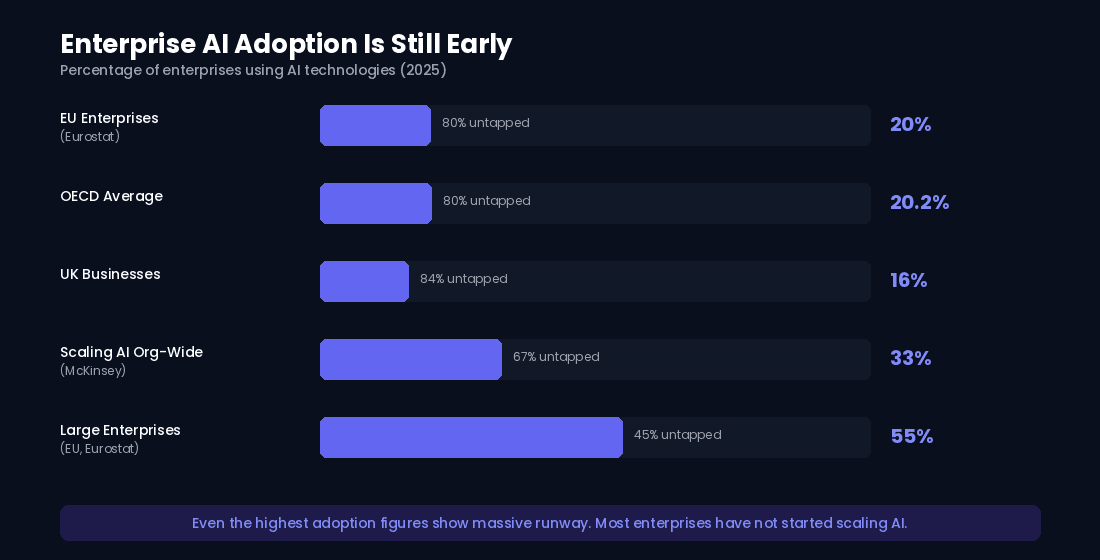
Despite the visibility of AI, enterprise penetration remains early. Eurostat reports 20% of EU enterprises with ten or more employees used AI technologies in 2025, with a steep size gap: 55% for large enterprises against just 17% for small ones. OECD data shows 20.2% of firms using AI in 2025, up from 8.7% in 2023, a 132% increase, but still early.
Deloitte's 2026 State of AI report found that worker access to AI rose 50% in 2025, but only 34% of organisations are truly reimagining their business with AI. McKinsey found only one-third of respondents were scaling AI across their organisations. The bottleneck is no longer whether the technology works. It is increasingly whether the organisation can deploy it safely, responsibly, and at scale.
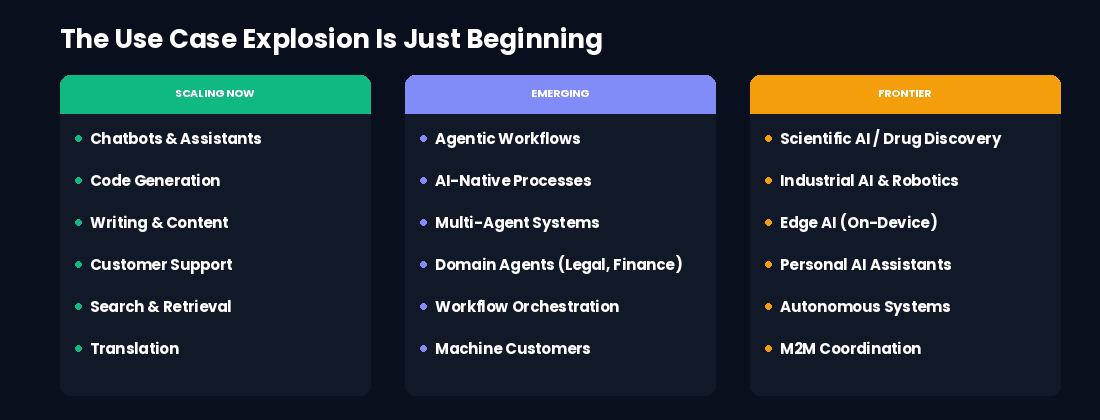
The use case explosion is just beginning
We have seen an explosion in chatbots, coding assistants, writing help, and copilots. But the larger categories are still nascent: agentic workflows, AI-native business processes, machine-to-machine coordination, scientific AI, industrial AI and robotics, edge AI, domain-specific agents, and personal AI. Models are improving rapidly, costs are falling, and each improvement unlocks new categories.
The constraint is not demand, it is energy and compute
The International Energy Agency makes it plain: affordable, reliable, and sustainable electricity supply will be a crucial determinant of AI development. Anthropic has secured approximately 3.5 gigawatts of future TPU capacity. OpenAI's Stargate initiative has discussed a 10-gigawatt buildout. Hyperscalers collectively are planning hundreds of billions in AI infrastructure spending.
A saturated market asks where the demand is. This market increasingly asks whether capacity can be built fast enough. That is a profoundly different signal.
Does this settle the bubble argument?
This evidence does not prove that every part of the AI stack is fairly priced. It does not mean every infrastructure dollar will earn an adequate return. History suggests platform shifts come with pockets of excess.
But it does weaken the simplistic version of the bubble thesis considerably. That argument rests on the claim that AI demand is mostly speculative. The evidence is increasingly inconsistent with that claim. Consumer usage is massive, at 900 million weekly active users on one platform alone. Enterprise monetisation is real, at a $30 billion run-rate for Anthropic and $25 billion for OpenAI, with more than a thousand enterprises paying over $1 million a year. Revenue growth is exponential. Agentic workflows consume 5 to 30 times more tokens per task. Unit costs are collapsing. Penetration remains at roughly 20% of enterprises across the EU and OECD. And the services market is opening up.
That is not the profile of a category that has exhausted its market. It is the profile of a category that may still be very early in converting capability into deployment, and deployment into economic value.
The real conclusion
The most useful way to think about AI now is not as a single product market but as the emergence of programmable intelligence as infrastructure.
As intelligence gets cheaper, more capable, and easier to embed, more of the economy becomes addressable. As systems become agentic, each workflow consumes more intelligence, not less. As governance improves, more enterprises move from experimentation to scale. As AI shifts from copilot to autopilot, it captures not just the software budget but the vastly larger services budget. And because adoption remains relatively early, the distance between today's usage and tomorrow's usage may still be very large.
The addressable market for intelligence is not literally infinite. But it may be far more expansive than the market still assumes. Because intelligence is no longer just a feature inside software. It is becoming a general-purpose economic input. And when a scarce input becomes abundant, programmable, and cheap enough to use everywhere, history suggests something important: demand does not plateau. It compounds.
Sources and references
- Gartner, inference cost projections for 2030, March 2026.
- arXiv, token price evolution analysis, 2603.28576v1.
- Sequoia Capital, Services: The New Software, March 2026.
- Bloomberg, Anthropic $30 billion run-rate, April 2026.
- TechCrunch, ChatGPT reaches 900 million weekly active users, February 2026.
- McKinsey, State of AI Trust in 2026.
- Eurostat, 20% of EU enterprises use AI, 2025.
- Deloitte, State of AI in the Enterprise 2026.
- International Energy Agency, Energy and AI, executive summary.
- OpenAI, State of Enterprise AI 2025 report.
Published by Brain AI. BrainAI Systems Ltd builds the reasoning and governance layer that lets enterprises automate decisions they could not previously automate.