AI Economics
The Technology Budget Is No Longer a Technology Question
It is becoming an organisational redesign question, and the leaders who see that early will set the terms for the next decade.
Over the past year I have found myself in many conversations that begin in a familiar way: a CEO, CFO, CIO or Chief AI Officer, an AI roadmap, and a technology budget being defended as a technology budget.
I think that framing is now the wrong one. AI is obviously technology. But the spending pattern building underneath these conversations has stopped behaving like technology spend. This essay is about why I think the line has moved.
The chart that changed how I read this
Most years, the enterprise tech spending data is a slow drift. Cloud takes a few points from on-premises. SaaS pulls a few points from licensed software.
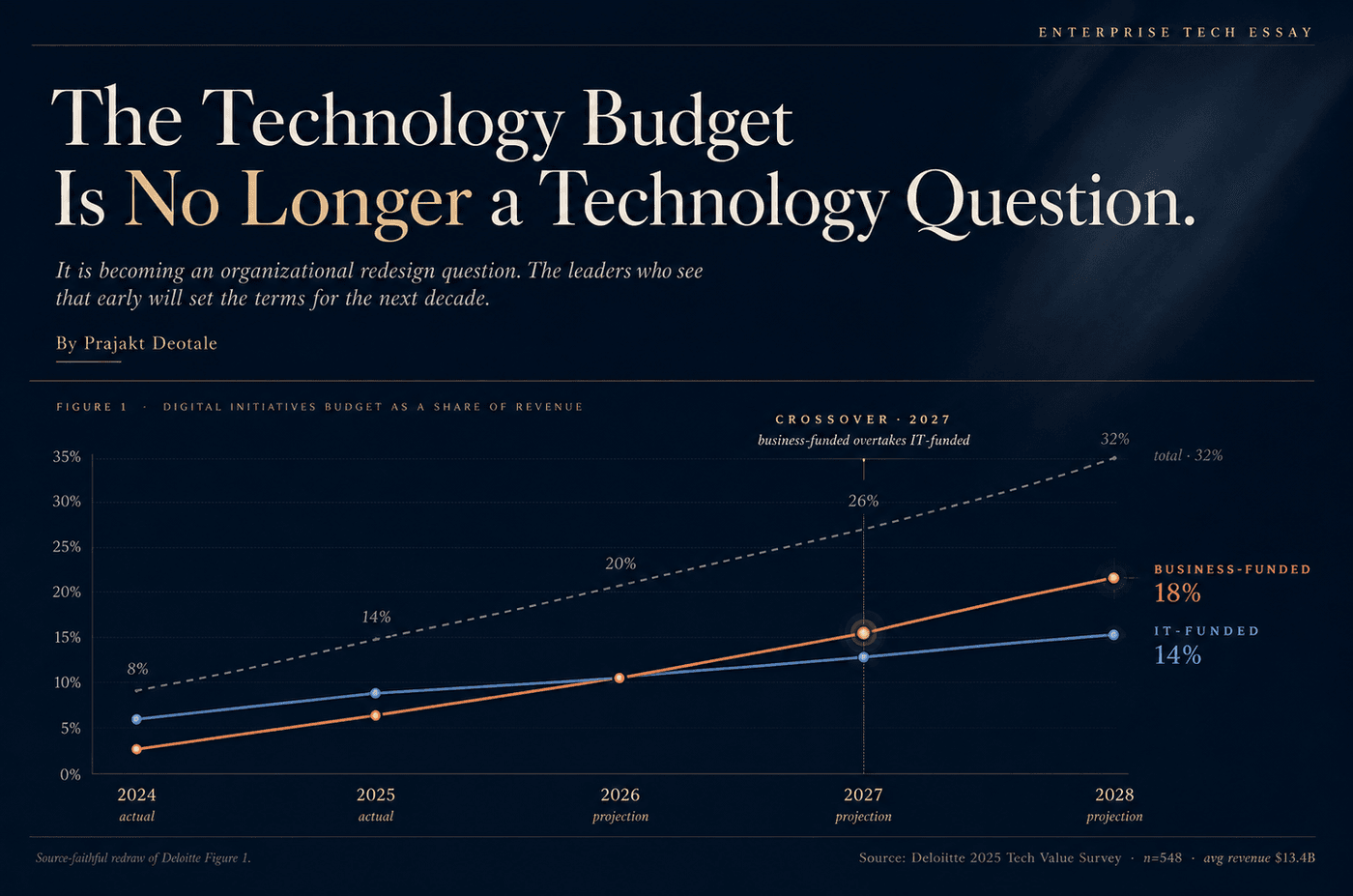
The 2025 Deloitte data does not look like that. The digital initiatives budget moved from about 8% of revenue in 2024 to about 14% in 2025 in a single year. But it is not the headline that matters. The headline that matters sits underneath.
Deloitte tracks the budget in two pieces: the IT-funded portion and the business-funded portion. In 2024, IT-funded spend was the larger of the two by a wide margin. By 2025, the gap had narrowed sharply. By 2026, on Deloitte's projection, the two lines meet. By 2027, the business-funded line overtakes the IT-funded line for the first time.
That is the chart that changed how I read this.
What it tells me is that the technology budget is not just doubling. The boundary of who controls the bigger half is moving outside the technology function. For the better part of two decades, shadow IT was the name we gave to the pieces of the technology estate that drifted into the business. We treated it as a governance problem. The 2027 crossover suggests it was never the problem. It was the early signal of a structural shift the data is now confirming at scale.
Why the lines diverge, and why the IT line still rises
When I show this chart to operators, the first question is always the same. If AI is supposed to recentralise spend into IT, why is the non-IT line growing faster?
The mechanism is actually simple, and once you see it the chart explains itself.
The IT-funded line keeps rising because AI's foundations have nowhere else to live. Data architecture, model governance, identity and access, inference infrastructure, and the cyber posture required to deploy any of this safely. None of that fits inside a marketing budget or an HR budget. The technology function has to scale to carry the weight of what gets built on top of it. Deloitte is direct about this in their own commentary: AI risks starving the rest of the technology portfolio if digital budgets do not continue to expand. The IT line is rising because the foundation is being asked to do more.
The business-funded line rises faster because the use cases land outside IT. Customer service is buying AI for handle time. Marketing is buying it for personalisation. Legal is buying it for review and contract drafting. Finance is buying it for close acceleration. HR is buying it for sourcing and screening. None of these functions are routing through IT to procure the tools. They are sizing the budget themselves, configuring against their own data, and absorbing the cost line into their own profit and loss.
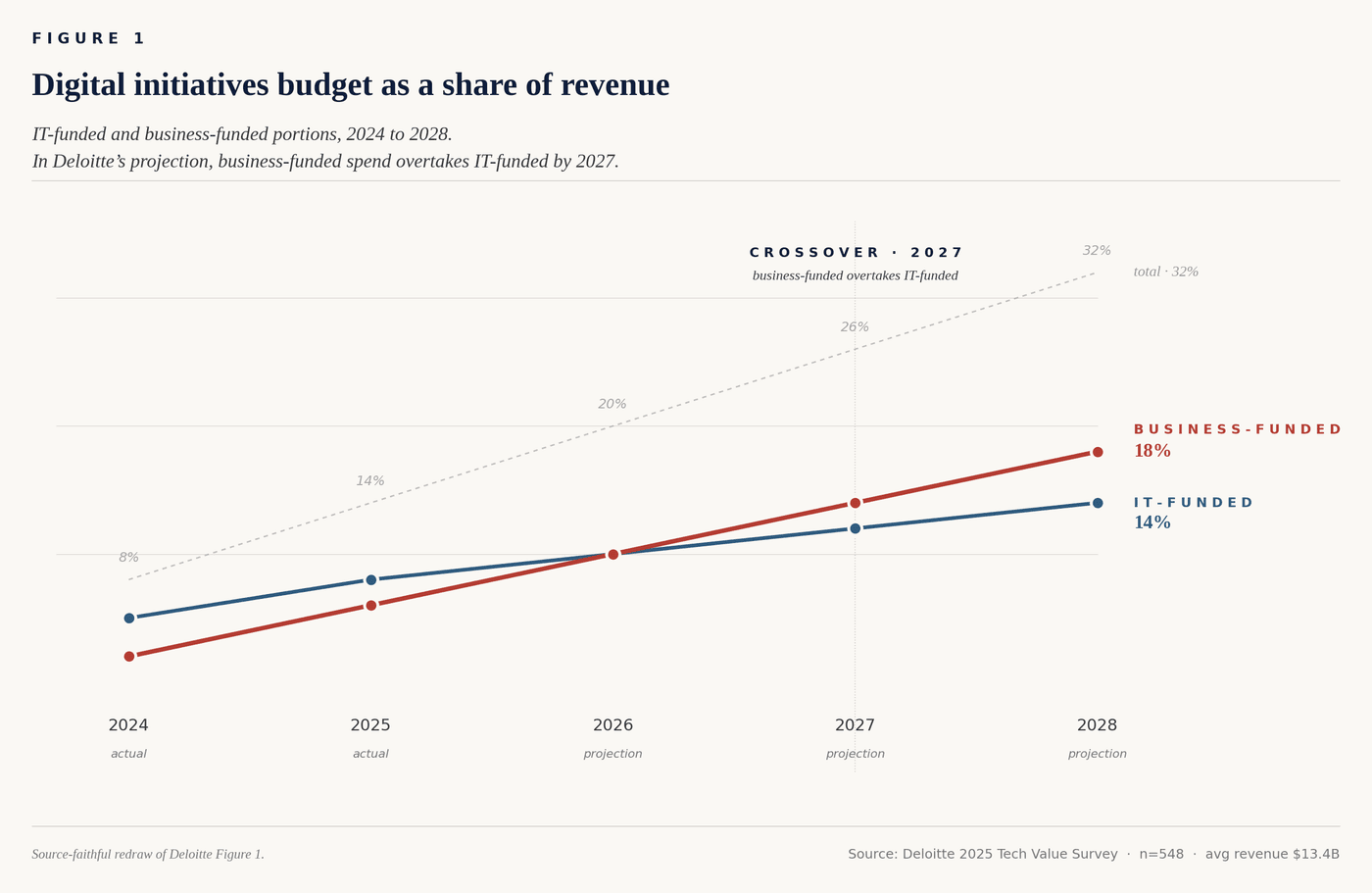
Both things are happening. Both lines rise. The non-IT line rises faster because that is where the application layer of AI is being absorbed. The IT line rises because it has to. The result is a structurally larger technology estate where the bigger half is no longer governed by the technology function.
That is not a budgeting story. That is an organisational design story.
What is actually being purchased
The other thing I keep coming back to is what enterprises are actually buying when they buy AI.
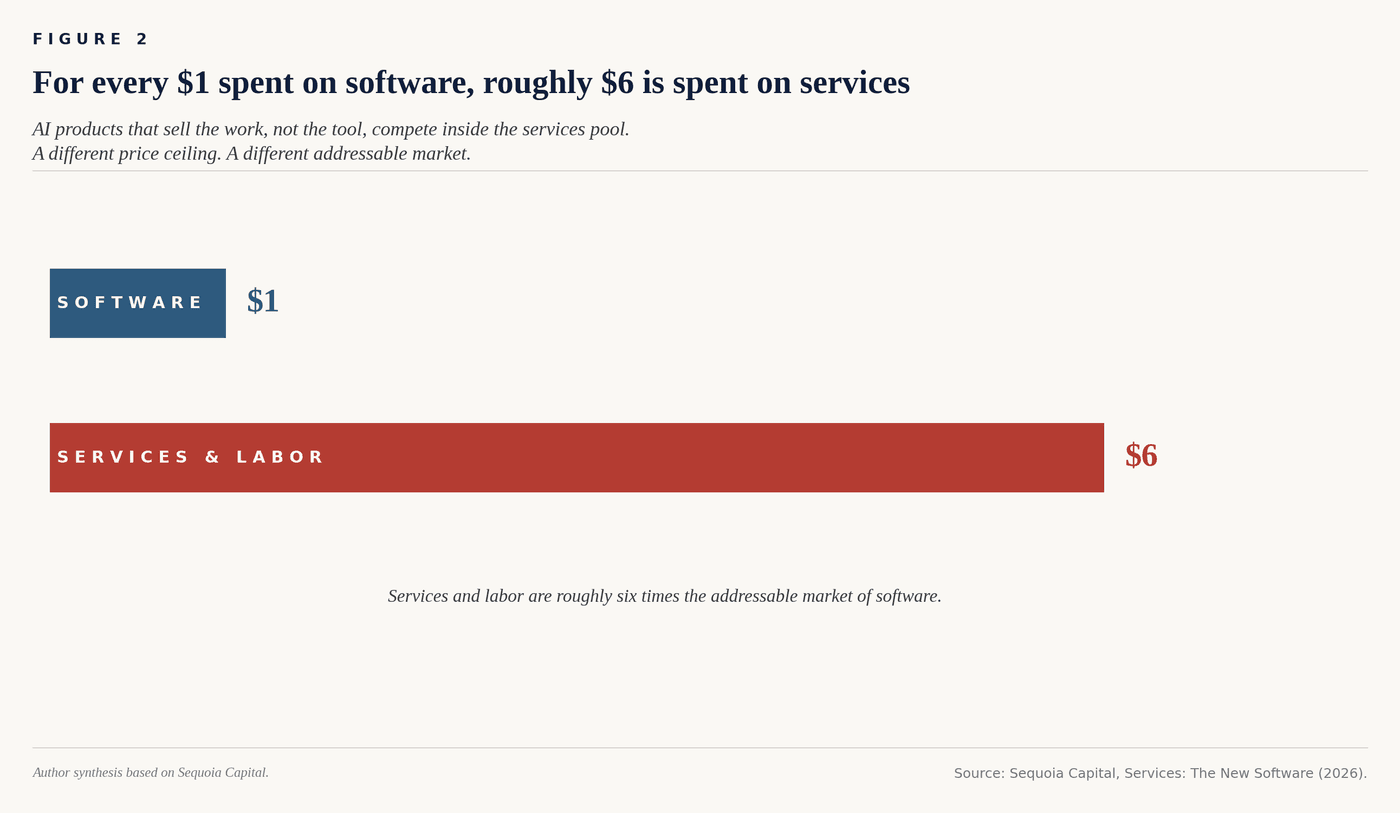
Sequoia put a useful frame on this in their Services: The New Software analysis earlier this year. For every dollar spent globally on software, roughly six dollars are spent on services, the labour that gets work done. Software, in aggregate market terms, has always been a small slice of the total cost of completing enterprise work. Services and labour have been the rest.
The AI products winning at scale right now are not selling better tools for human workers. They are selling the work itself. They compete inside the labour pool, not the software pool. That is a completely different market and a completely different price ceiling.
This is the part I think most enterprise tech budgeting still misses. If you measure the AI opportunity as software spend, the curve looks stretched. If you measure it as the cost of completing the work, it has barely started. The 32% of revenue Deloitte projects by 2028 only looks aggressive against a software anchor. Against a services and labour anchor, 32% is the early phase, not the late one.
Which is why the budget conversation and the organisational conversation are now the same conversation.
Where the labour pressure shows up first
If AI is competing for services and labour budgets, and the data increasingly says it is, then the next question is not financial. It is structural. What happens to the labour those budgets used to fund?
I want to be careful here. The temptation is to make AI carry the weight of every workforce headline currently in the news. It cannot, and it should not. Many of the layoffs visible in the technology sector right now are also responses to overhiring during 2020 to 2022, post-ZIRP cost discipline, and rising compute costs eating into margin. AI is one force among several. The honest read is to say so.
What I do think is worth saying, because it is grounded in the historical record rather than in current headlines, is this. Major general-purpose technology transitions tend to produce labour pressure first in the sectors closest to adoption.
The Industrial Revolution did not begin restructuring labour across the broad economy. It began restructuring labour inside textiles, the industry adopting the new spinning and weaving technologies first. The Luddite movement of 1811 to 1816 was a textile-worker phenomenon, not a general workforce one. The pressure propagated outward to broader manufacturing only as the technology matured.
Electrification followed a similar pattern. The early organisational impact was felt inside manufacturing, where electric motors eventually changed factory layout, workflow, and the relationship between power and production. The wider economy felt it later.
The personal computing wave first put sustained pressure on routine clerical and administrative work, the kind of codifiable office activity that software could gradually absorb. The internet transition compressed dramatically inside travel agencies, classified-ad businesses, and directly disintermediated retail before the broader economy felt it.
The pattern is consistent. Labour pressure first appears inside the industry closest to the technology, then propagates outward as the technology matures.
What is distinctive about this transition, and this is the observation I have not been able to find a precedent for, is that the technology builders themselves are showing labour pressure during the build-out phase, not after diffusion. In every prior transition, the builders of the technology hired aggressively while the directly displaced industries shrank. The two groups were distinct. In this transition, they sit much closer together, because AI's first competent applications happen to be concentrated in tasks performed inside technology firms themselves: code, support, content, recruiting.
I do not think this means the historical pattern is broken. I think it means the historical pattern is compressing. The propagation that took decades in prior transitions may take years in this one. The forward-looking implication is open-ended on purpose, because the pace and sequence of propagation are genuinely uncertain. But the direction is not.
The optimistic frame is the one that has held up across every prior transition. Each one expanded the economic pie. Each one created entirely new categories of work. Each one rewarded the workers and firms that adapted earliest with most of the upside. The current phase is the transition, not the destination. The leaders who treat it as a cost-takeout exercise will solve the wrong problem. The ones who treat it as an organisational redesign will set the terms for what comes next.
That is the specific work I think the next eighteen months are about.
What the redesign actually looks like
I work mostly with telecom operators, and telecom is a useful case study right now precisely because it has stopped being theoretical. The most AI-fluent industry has begun repositioning, and what that repositioning looks like is becoming visible in the operating data.
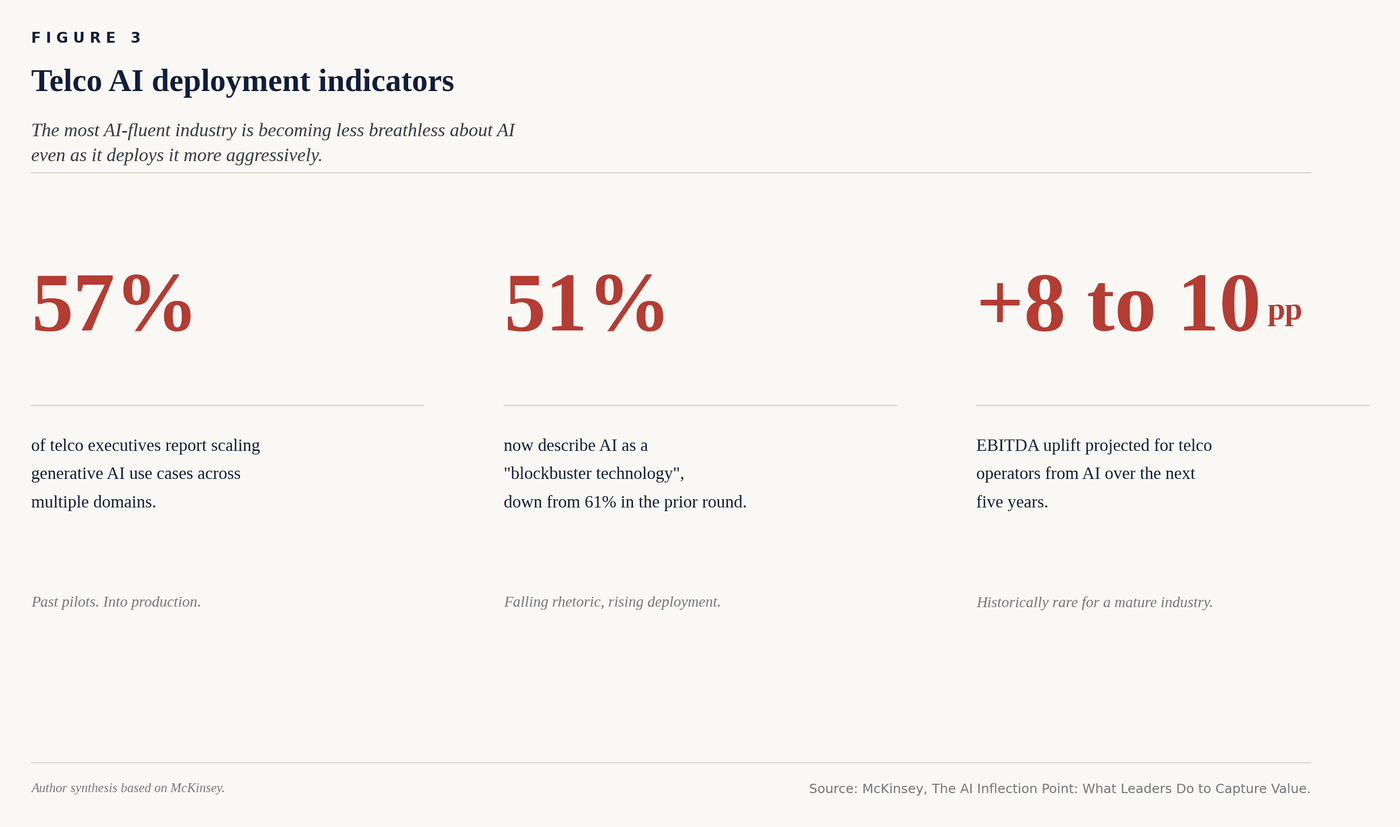
McKinsey's recent telco analysis finds 57% of telco executives report scaling generative AI use cases across multiple domains. The same survey shows the share of executives describing AI as a blockbuster technology actually declined, from 61% in the prior round to 51% now. The most AI-fluent industry is becoming less breathless about AI even as it deploys it more aggressively. That combination, falling rhetoric and rising deployment, is what industrial maturation looks like. And McKinsey projects AI could deliver 8 to 10 EBITDA percentage points to telco operators over five years. A structural margin uplift of that size is historically rare for a mature industry.
The clearest production data point in the public record right now is AT&T's deployment with Microsoft Azure. More than seventy unique generative AI solutions in production. Nine billion daily tokens of measured deployment volume. More than a hundred thousand employees using generative AI tools. Thirty-three percent faster agent productivity in customer-service interactions. Year-on-year return improvement reported by the deployment team.
What that case shows is not that AT&T has an AI strategy. Plenty of companies have AI strategies. What it shows is what an AI-fluent industry's production deployment template looks like at scale. Solutions in production. Six-figure employee adoption. Billions of tokens in measured volume. An EBITDA path. The template is portable. Other industries with comparable cost structures and customer bases can read AT&T's deployment as an operational reference, not an aspirational one.
The reason telecom matters here is not that it predicts what every industry will do next. It is that it shows what the redesign looks like once it stops being a technology project and becomes an operating model. That distinction is the entire point of this essay.
The bubble question, briefly
I should address the framing question that keeps appearing in this debate, because it is a fair one. Is this a bubble?
A classical bubble shows demand weakening while supply catches up. Valuations compress before fundamentals do. The 2025 to 2026 data does not look like that pattern. Budgets are expanding, not contracting. The supply side is still racing to catch up. Production deployments are scaling, not stalling. Operational metrics are improving where they are being measured.
This is interpretation, not proof. Plenty of individual AI investments will fail to produce returns. The MIT NANDA work that Deloitte itself cites finds only about 5% of generative AI pilots deliver sustained value at scale, and that gap is real. The aggregate spending curve being structurally sound does not mean every dollar within it will be well spent.
The risk I think is more concrete than the bubble framing is measurement mismatch, where leaders size AI as a software line item when it is structurally a services phenomenon, and foundation starvation, where AI dollars go into models while the data, security, and identity infrastructure those models require to deploy safely stays underfunded. Deloitte's own report flags this directly. Only 25% to 32% of organisations invested in identity management, federated security, or zero trust in the past year, even as AI deployment accelerated. That gap is the more immediate strategic risk in the data than any aggregate-curve bubble.
What I would ask
If I were writing this for the leadership team I worked with most recently, I would close on the questions I think now matter more than the budget.
When 25 to 30% of revenue is being deployed against work rather than against software, what does the organisation actually look like? Which functions stop being functions and become flywheels? Which centralised capabilities, meaning data, governance, security and infrastructure, have to be funded as foundational rather than as project costs? Where does the labour redesign live in the org chart, and who owns it?
These are not budgeting questions. They are design questions. And they are the right questions, because the technology budget is no longer a technology question.
The leaders asking them in 2026 will own the next decade. The leaders still arguing about the IT line will be answering them in 2030, by then on someone else's terms.
The opportunity here is not to manage the curve. It is to design what comes out the other side.
Sources
- Deloitte Center for Integrated Research, AI and tech investment ROI, 2025 Tech Value Survey, October 2025. n=548, average revenue $13.4B. Digital initiatives budget 7.5% in 2024 to 13.7% in 2025, with a continuation projection to roughly 32% by 2028, the IT-funded and business-funded split with crossover by 2027, 74% AI investor share, 36% average AI share of digital budget, cybersecurity investment gap of 25% to 32%, and the MIT NANDA 5% pilot success citation.
- Sequoia Capital, Services: The New Software, 2026. The $1 to $6 software-to-services ratio.
- McKinsey & Company, The AI Inflection Point: What Leaders Do to Capture Value, telco industry analysis. 57% scaling generative AI across domains, 51% against 61% on framing, and the 8 to 10 percentage point EBITDA five-year projection.
- Microsoft customer story and AT&T deployment with Microsoft Azure: more than 70 unique generative AI solutions in production, 9 billion tokens, more than 100,000 employees, and 33% faster agent productivity in customer-service interactions.
Published by Brain AI. BrainAI Systems Ltd builds the reasoning and governance layer that lets enterprises automate decisions they could not previously automate.